A source of information for the tramper, SAR and DOC
One thing you will find in every back country hut in New Zealand is the ubiquitous green and gold intentions book. They are supplied by the Department of Conservation and are there to impart useful information to trampers and to record the passage of anyone who has stayed at or visited that hut.
 |
| Cover of the ubiquitous back-country hut intentions book |
The front of the book has pages of excellent general tramping information covering a broad range of topics This is followed by a number of pre-formatted pages where you can add you name, date of arrival, hut payment method, home location and intended movements once you leave the hut.
Every solo tramper or a designated member of any group should be filling in these details at each and every back country hut they are visiting.
Every solo tramper or a designated member of any group should be filling in these details at each and every back country hut they are visiting.
 |
| Typical entries in a DOC Intentions Book, Kahikatea Shelter, Pelorous Bridge |
You will often find the intentions book sitting on the dining table in the hut but they can also be found in specially built book holders on a convenient wall, bunk or flat surface. They usually have a pen attached or close to the book but you should always carry your own pen for writing messages in an emergency.
 |
| In Lakehead hut, Nelson Lakes National Park...note hut book holder... |
 |
| ..a more elaborate intentions book holder in Bark Bay Hut, Abel Tasman NP... |
Reading the entries in the intentions book is one of the stand out pleasures I get when staying in a hut...you will read stories of raging rivers crossed, mountain peaks conquered, bush bashed, new routes discovered, epic meals consumed, adventures long dreamed of finally completed.
If you are a keen tramper like me you will get to recognize some of the names...legendary names like Spearpoint, Barnett, Potton, Ledbrook and Salisbury but also others less well known. You will also see tramping clubs, walking clubs, people you work with or might have once met in some tramping hut.
There is almost always something interesting and or relevant to be gleamed from the pages.
 |
| Hut book open in John Tait Hut ready for Jon to complete... |
Lets have a look at this icon of the back country hut and see what information it can impart to us.
What information will I find in an intentions book
The DOC intentions book is jammed full of valuable information for the novice and experienced tramper alike and it is well worth taking time to read the first ten pages of the book the next time you are at a hut.
 |
| The hut intentions book on a table in Rod Donald Hut, Banks Peninsula |
I thought it might be useful to break the information down and look at the contents in the front of the book on a page by page basis. Let us take a typical hut intentions book say from Mangetepopo Hut in Tongariro National Park and look at that information....
 |
| Hut intentions book: front page and hut details...Mangatepopo Hut |
Headings covered in the front of a DOC intentions book
Each of the pages has a different heading, the first heading is.....
Hut Users Guide
These are general recommendations on proper behavior and good etiquette in and around back country huts. This includes making space for newcomers, not taking more space than required, not moving another trampers gear, conserving firewood, cleaning huts before you go etc. etc.
Huts are a communal space & tramping is a communal activity but modern society is anything but communal. The modern world is programmed for self gratification so people can often be selfish and have little thought or sympathy for those around them.
Huts are a communal space & tramping is a communal activity but modern society is anything but communal. The modern world is programmed for self gratification so people can often be selfish and have little thought or sympathy for those around them.
 |
| Tramping involves an awful lot of communal living.... |
Most of this should not need explanation to any tramper but as I have seen recently people need to be educated. This stuff is second nature to people who have spent time in the military or emergency services if they come from a big family or have attended a boarding school or halls of residence.
I personally feel the old trampers ethos of mutually supportive self sufficiency is eroding....trampers, hunters and climbers used to get along well in the confines of a hut. I see increasing tension and more selfish behavior... I think it is directly related to the growing numbers using the back-country hut system.
More crowded conditions = more aggro = less enjoyable tramping!
I personally feel the old trampers ethos of mutually supportive self sufficiency is eroding....trampers, hunters and climbers used to get along well in the confines of a hut. I see increasing tension and more selfish behavior... I think it is directly related to the growing numbers using the back-country hut system.
More crowded conditions = more aggro = less enjoyable tramping!
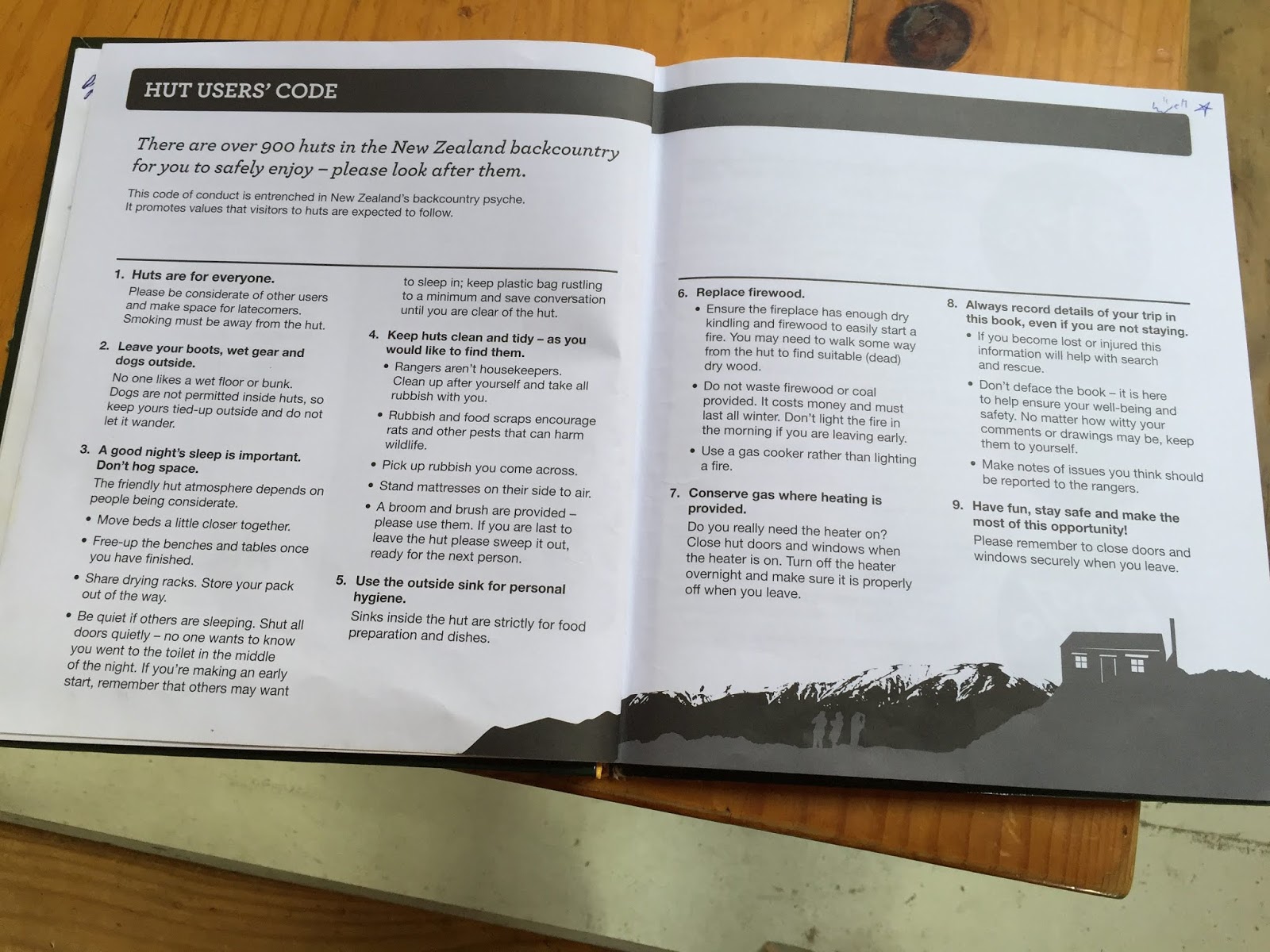 |
| Hut intentions book: the hut users code.... |
The basic tenet for happy hut life should always be...show kindness and consideration to those around you...
What to do in an emergency:
This page contains some basic information about immediate actions you should consider in the event of an emergency. There is a list of emergency service phone numbers, advice on activating a PLB and the information you need to provide to SAR/DOC/Police if you manage to contact them and can pas this information on.
 |
| Hut intentions book: Emergency information |
This stuff is vital and is probably some of the most important information provided in the intentions book...
Don't get sick/Look after the environment(Leave no trace):
This is general health and hygiene information for outdoor enthusiasts...not everyone knows how to keep themselves healthy in a communal outdoor situation. We are having increasing problems with gastrointestinal viruses at huts...Norovirus and Salmonella are two of the worst. A few key points;
- wash your hands regularly and thoroughly
- keep human waste out of the water table
- use outside sinks for washing/cleaning your teeth.
- Indoor sinks for food preparation, dish washing only
- treat drinking water if recommended or required
- if you get sick take steps to minimise the spread of germs
- inform the authorities if there is a widespread outbreak of sickness
 |
| Hut intentions book: LNT Leave No Trace information |
When they talk about looking after the environment they are talking about Leave No Trace (LNT) principles. The seven LNT principles are intended to minimise your impact on the outdoor environment...they are;
- Plan ahead and prepare
- Travel and camp on durable surfaces
- Dispose of waste properly
- Leave what you find
- Minimise the effects of fire
- Respect wildlife and farm animals
- Be considerate of others
You should always try to minimise your environmental impact...remember....take only photos, leave only footprints!


General Survival Information
There are a couple of pages of general survival information that can help to keep you safe when you are out exploring the outdoors. The first two are about hypothermia and navigation.
Hypothermia is one of the most dangerous health concerns when tramping...it is an over cooling of the body's core temperature which can lead to lethargy, irrational thought patterns, physical collapse and ultimately death. It is not as prevalent as it used to be due to advances in tramping clothing BUT there are still several deaths a year from hypothermia.
It can happen to anyone..I have personally had very mild hypothermia a couple of times over the years...you often don't realise you have hypothermia when it is happening to you. This is because one of the symptoms is dis-associative behavior i.e. you are acting out of character but do not realise you are.
On my recent tramp on the Routeburn track last December we had several people in the mid stages of hypothermia at Howdon Hut. It was perfect weather for it...cold, windy, heavy rain and people woefully ill prepared to be out in those conditions. Luckily some of us old timer trampers recognised the symptoms and took action to assist the people affected. I actually had my PLB out at one stage as one woman was looking really unwell but she recovered with warm clothes, some food and a couple of hours of rest.
 |
| Hypothermia is a silent killer here in New Zealand... |
It can happen to anyone..I have personally had very mild hypothermia a couple of times over the years...you often don't realise you have hypothermia when it is happening to you. This is because one of the symptoms is dis-associative behavior i.e. you are acting out of character but do not realise you are.
 |
| Cold, wet and windy conditions contribute to hypothermia... |
 |
| Awful weather on the Routeburn Track in December 2019... |
You need to know the signs of hypothermia and how to deal with it effectively both for your sake and for those around you. The hut book is a good start but read some general tramping manuals, books on outdoor medicine, look for authoritative online information and keep yourself and your tramping buddies safe.
 |
| Hut intentions book: survival information |
The information about navigation is not so much how to as how to avoid making navigation errors. Basically it is important to always be in the here and now i.e keep your mind on the task at hand...stay together if in a group, regroup on a regular basis, think before you act, consider the results of your actions and do not let outside distractions lead you from the righteous path...hallelujah brothers and sisters!
 |
| Stay together when tramping in a group...... |
The second two topics are about weather and river crossings....if you are new to this country be aware that we can have warm sunny conditions in the morning and be in the middle of a raging beast of a storm by 12 noon! We have a oceanic environment so our weather is unpredictable, fickle and changes in a heartbeat. Keep up to date with weather forecasts, know how to identify different weather conditions and be prepared for all eventualities with good clothing and appropriate outdoor skills.
 |
| Hut intentions book: outdoor safety information |
River crossing is a vital skill in New Zealand as we are surrounded by potentially dangerous lakes, rivers and the oceans. So many people drowned in colonial times that it was known as the "New Zealand Death" !!! Even now with our modern gear and vastly better water skills people are constantly dying crossing waterways...point of illustration...six people have already drowned in tramping accidents since January 2020.
 |
| Stop, look, think...is this river safe to cross!!!! |
The information in the intentions book is a very condensed version...the best thing you can do is to take an approved river crossing course with experienced instructors. You also gain experience as you tramp...I have been tramping for more than 20 years and I am still learning new river crossing skills all the time.
Key points here are:
If there is any doubt around crossing a river DONT...find a better crossing place or wait for better conditions.
Always ask...do I need to cross that river???
Key points here are:
- Always scout possible river crossing points before entering the water
- Ensure that your exit from the opposite side of the river will be smooth and safe
- Never cross a river solo if you can cross as part of a group.
- If you must cross solo use a stout branch as a crossing aid
- Do not cross a river if it is flowing faster than walking pace, is discolored or you can hear debris rolling along the bottom
- Do not cross a flooded river.
 |
| Never cross a fast flowing, discolored and swollen river... |
If there is any doubt around crossing a river DONT...find a better crossing place or wait for better conditions.
Always ask...do I need to cross that river???
What goes wrong/Prevent accidents occurring
A good way to enhance your safety outdoors is to cultivate an interest in the stories of those who have come to grief. You often find that outdoor accidents are repetitive...they happen in the same location or the injury has happened to many different people. If you learn about the way other trampers have injured themselves you can adjust your own behaviour to avoid the same result.
 |
| Hut intentions book: consider outdoor accident information |
Good sources of information about outdoor accidents abound...the Mountain Safety Council or MSC publish regular reports on the accidents that occur in the New Zealand outdoors. You can also find discussions about outdoor accidents in the FMC journal Backcountry as they have a regular column on this topic called Backcountry Accidents.
An excellent book about this subject is High Misadventures: New Zealand mountaineering tragedies and survival stories by Paul Hersey.
An excellent book about this subject is High Misadventures: New Zealand mountaineering tragedies and survival stories by Paul Hersey.
 |
| Backcountry has a regular column about outdoor accidents... |
I just did a quick search of our library catalogue and we have over 20 books on the subject...other libraries will have similar numbers.
The outdoor safety code
The outdoor safety code is a New Zealand specific list of steps you should take before undertaking any trip to the back-country. Following these steps can help to keep you safe, healthy and happy while tramping.
The 5 key points are:
The 5 key points are:
- Plan your trip
- Tell someone your plans
- Be aware of the weather
- Know your limits
- Take sufficient supplies
Follow these steps every time you go out tramping to help get you home safe....
 |
| Hut intentions book: the outdoor safety code |
 |
| Hut intentions book: how to make it home..... |
Lastly there is a list of important emergency numbers on the inside cover of every hut book...if you have cell reception use these numbers to contact DOC/SAR/Police.
 |
| Hut intentions book: useful phone numbers/email addresses |
Note: If you arrive at a hut and find the intentions book is full please let the closest DOC office know so they can replace them. I often stop at local DOC offices and ask if they need one taken to a hut on my intended route. They appreciate the help....
Why it is important to fill in your personal details
The actual purpose of the intentions book is as a guide to SAR/DOC if you become lost and to gather generalized information about who is staying in that particular hut. It has never and will never be used to try to track down people who have not paid their hut fees. You have nothing to lose and everything to gain by filling out the intentions book...
 |
| Hut intentions book on table in Rod Donald Hut, Banks Peninsula |
DOC use the information in the hut book to parcel out funding for such things as track maintenance, hut maintenance and replacement of old facilities. More entries (i.e: more people visiting the hut...) means more dirty lucre for that location. If you do not sign the book DOC (as a government department is apt to do) just assume that nobody is using the hut.
No usage statistics = no money....it is as simple as that!!!!
 |
| Hut intentions book: in depth details of individuals/parties |
The other main use for the hut intentions book is as an aid to Search and Rescue operations for lost trampers. If you go missing in the hills or forests the very first place SAR will go to look for information about you is in the intentions books. If they know for instance that you were at Upper Travers Hut one night but did not turn up to West Sabine the next it immediately narrows the radius of any search efforts.
 |
| Hut intentions books are the first place DOC/Police/SAR look when you go missing... |
You should become religious in filling out the intentions book...after grabbing a bunk and putting on a brew it is the next considered action I take every time I arrive at a hut. Make sure you clearly note your intended route as well as any alternate routes you might be using. Try to encourage other hut users to also fill in their intentions but obviously don't pressure them to do so.
The hut book as an expression of being...
I have seen a variety of different things in hut books but other than track information the main things you see are art works and non tramping related writing. People often get bored in huts once the meal has been consumed and the card game or book doesn't entice as once it might have.
 |
| Resting on my bunk in Magdalen Hut...bit of light reading...brew to hand...nice!!! |
Many people have artistic talents and when you are sitting bored in a hut on a zero day it always seems like you are looking for something to do...hey I know lets draw in the hut book. The quality ranges from poor to excellent..the example below is a very nicely drawn picture of a Weta from the hut book in Magdalen Hut. This is typical of the genre...rivers, mountain vistas, flora and fauna are all well represented.
Little stick men with huge appendages and stick women with massive chestal shelves also put in a regular appearance...
Little stick men with huge appendages and stick women with massive chestal shelves also put in a regular appearance...
 |
| Hut intentions book: artwork on the front cover of a book |
 |
| Closer detail of artwork in a hut intentions book |
I have often seen poetry, ditty's, haiku's, philosophical ramblings and deep inner thoughts expressed in intentions books. Usually they are thoughtful and considered but sometimes they can get a bit ribald. So long as you don't go too far.....try to limit the swearing thanks. Don't rant about 1080 either!!!! Remember kids stay in huts and they can read your nasty, smutty comments just as well as an adult...
If you are walking along a section of the Te Araroa Trail you will often see communications between various trekkers telling each other where they intend to go, where to meet up, good or bad track conditions and if they are doing o.k. It makes for some interesting reading....especially the colorful nicknames.
 |
| Hut intentions book: an ongoing (slightly sleazy) conversation in a book.. |
What about Jon...does he add his own personal contribution to hut books?
By gawd yes he does...this is my usual witty entry...
By gawd yes he does...this is my usual witty entry...
I went to say goodnight to Pwarse the fish,
I said '...Goodnight Pwarse..."
If you ever see this in a hut book then you know I have visited at some stage.....I cannot claim authorship of this ditty, one of my school mates made it up for our end of year journal back in 1985.....I just like it.
I have also been known to quote from the Anonymous riff on West Coast rain...
I look forward to reading your intentions book entries in the future...
I have also been known to quote from the Anonymous riff on West Coast rain...
 |
| Anonymous poem about New Zealand rain... |
I look forward to reading your intentions book entries in the future...


